Slab leak repair
A leak under the concrete floor is found, then the pipe is repaired through a small opening or rerouted through the walls or attic.
Find your problem below, read how it gets fixed, and call us when you want a licensed local plumber to come out.
Browse the repair groupsWe sort our plumbing repairs in Bullhead City into four groups so you can find yours quickly. Leaks and slab leaks cover water escaping where you cannot see it. Pipes and water lines cover breaks in the supply side. Drains, toilets and faucets cover the fixtures you use every day, and the last group covers water heaters.
Start with the symptom. The right hand column takes you to the page that explains the fix in detail.
| The symptom | The usual culprit | The page to read |
|---|---|---|
| A warm patch of tile, or a hiss with all the taps closed | A pressurized pipe leaking under the concrete floor | Slab leak repair |
| The water meter keeps turning when nothing is running | Water escaping inside a wall, beneath the slab or out in the yard | Leak detection |
| Water spraying from a wall, ceiling or garage pipe | A burst pipe, a pinhole leak or a cracked fitting | Pipe repair |
| A soggy spot in a dry gravel yard or weak pressure everywhere | A leak in the buried line from the meter | Water line repair |
| A basin, tub or shower that empties slowly or stays full | Grease, hair or scale building up in the drain line | Drain cleaning |
| A toilet that keeps running, rocks or leaks at the floor | A worn flapper, fill valve or wax ring | Toilet repair |
| A dripping spout or a damp cabinet under the sink | A worn cartridge, a scaled aerator or a loose connection | Faucet and sink repair |
| No hot water, rusty water or a puddle under the tank | Sediment, a burned out part or a tank that is simply worn out | Water heater repair |
| Error codes or hot water that turns cold mid shower | Scale in the heat exchanger or a faulty sensor | Tankless water heater repair |
If more than one row fits, mention all of it when you call. Two symptoms together often point to the real cause faster than either one alone.
Water that escapes under pressure does the most damage, so these four repairs are the ones to move on quickly. All four start with finding exactly where the water is going.
A leak under the concrete floor is found, then the pipe is repaired through a small opening or rerouted through the walls or attic.
Listening gear, pressure tests and moisture meters narrow down a hidden leak so only a small area needs opening.
Burst sections, pinhole leaks in copper and cracked fittings are cut out and replaced with new pipe that holds pressure.
The buried supply line between the meter and the house is dug out at the leak and repaired or replaced.
These fixtures get used every day, and hard water wears their small parts faster than you might expect.
Clogged kitchen, bathroom and laundry drains are cleared with the right cable size and flushed to make sure they run freely.
Running tanks, weak flushes, clogs and leaks at the base are traced to the worn part and fixed.
Drips, low flow and leaks under the sink are repaired with new cartridges, washers, supply lines or a new faucet.
Most homes in Bullhead City heat water with a tank in the garage, and a growing number use a tankless unit on an outside wall. Both suffer from scale, and tanks also work through very hot summers in a garage that holds the heat.
Our water heater repair page covers tank heaters, gas and electric. The tankless water heater repair page covers error codes, descaling and units that shut off mid shower.
How to flush a water heater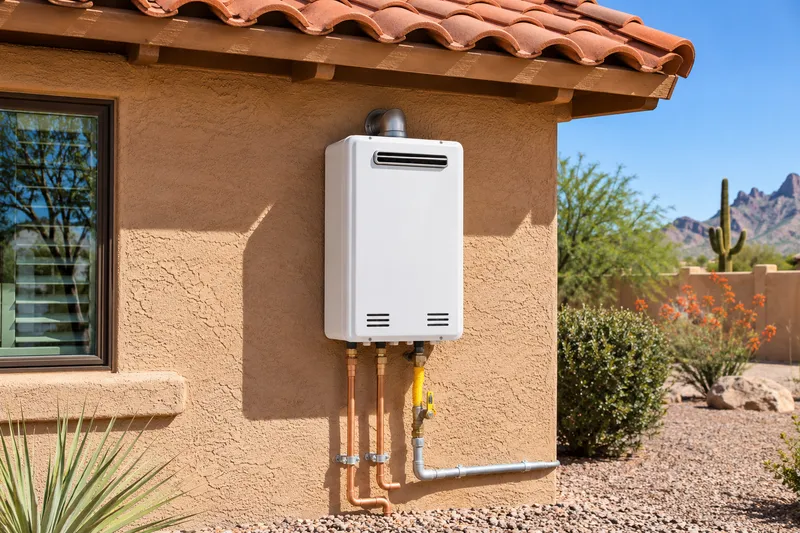
Whichever repair you need, the plumber starts by finding the cause rather than guessing. Before any tools come out, you learn which part gave up and how it can be put right, and nothing goes ahead until you agree.
When the job is done, the plumber runs the water, checks the repair for leaks and shows you anything worth keeping an eye on.
Plumbing problems in Bullhead City homes tend to come in pairs. Knowing the usual partners helps you describe the whole picture when you call.
When usage jumps and a patch of tile feels warm, a hot water line under the slab is the usual suspect. Leak detection confirms the spot, and slab leak repair fixes it, either through the floor or by rerouting the line.
White crust on faucets and a heater that pops or rumbles both come from hard water. The faucet may need a new cartridge, and the tank may need a flush or a repair. Our guide to hard water and your plumbing explains why the two go together.
When a tub drains slowly and the toilet next to it gurgles, the two fixtures may share a partly blocked branch line. Clearing the branch often fixes both, which is why the plumber will ask about every fixture in that bathroom.
Damp drywall in the garage plus weaker flow at the taps can point to a leaking supply pipe in that wall. The plumber opens a small section, finds the leak and replaces the damaged length. See pipe repair for what that involves.
Three short guides that answer the questions people ask us most about leaks, high water use and scale.
We handle the repairs listed on this page, which cover leaks, pipes, the main water line, drains inside the home, toilets, faucets and water heaters. Work on the main drain that leaves the house underground is not something we handle. If your problem is not listed, call and ask.
Start with leak detection. Running water with every fixture off means a leak somewhere, and finding it comes before the repair. If it turns out to be under the slab, the plumber moves on to the slab leak repair.
Yes. Tell us everything you have noticed when you call. A dripping kitchen tap and a toilet that keeps refilling can both be handled during one trip.
Plan on a grown member of the household letting the plumber in, pointing out the trouble and approving the work. The plumber also needs access to the main water valve and, for heater work, to the gas or electric shut off.