Tankless Water Heater Repair in Bullhead City, AZ
If your tankless heater flashes an error code or runs cold in the middle of a shower, a local plumber can repair it.
See why tankless units stop heatingTankless water heater repair in Bullhead City starts with scale
Tankless water heater repair in Bullhead City often comes down to one thing, mineral scale. A tankless unit heats water as it flows through a narrow heat exchanger, and hard water coats those small passages much faster than the inside of a tank.
As scale builds, the unit overheats, flashes error codes, cuts out during long showers or delivers less hot water than it should. Descaling the heat exchanger clears most of these faults if it is done before the parts are damaged.
If your unit is a few years old and has never been descaled, it is worth booking a service visit before the faults begin. A clean heat exchanger heats water faster and works less hard on the hottest days of the year.
How hard water and heat affect a tankless unit
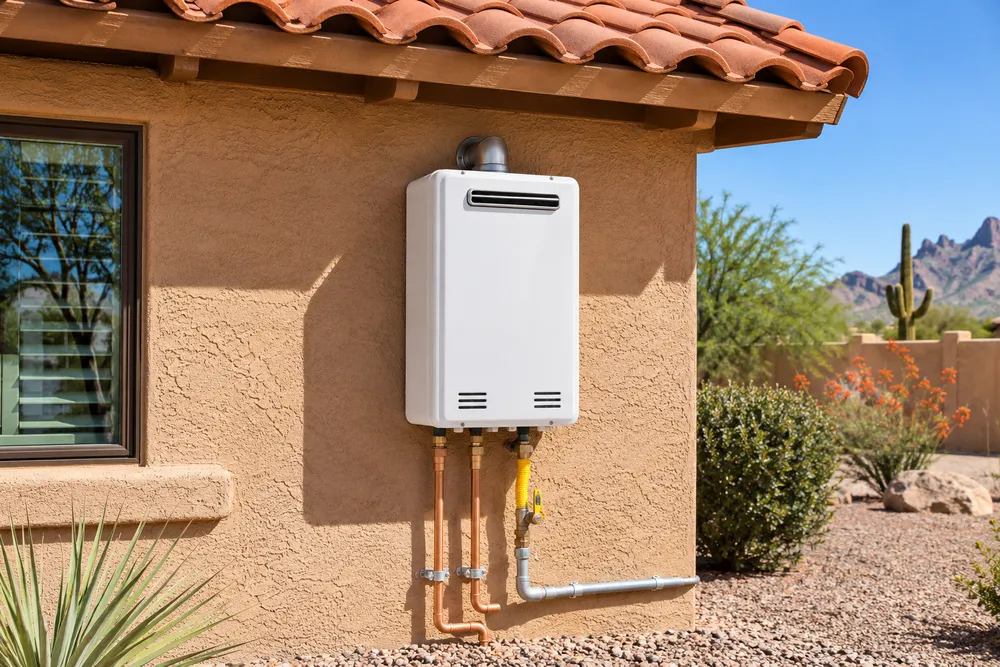
In warm climates many tankless heaters are mounted on an outside wall, where they sit in direct sun through a long summer. The units are built for it, but heat ages seals and wiring a little faster, and dust can collect in the air intake.
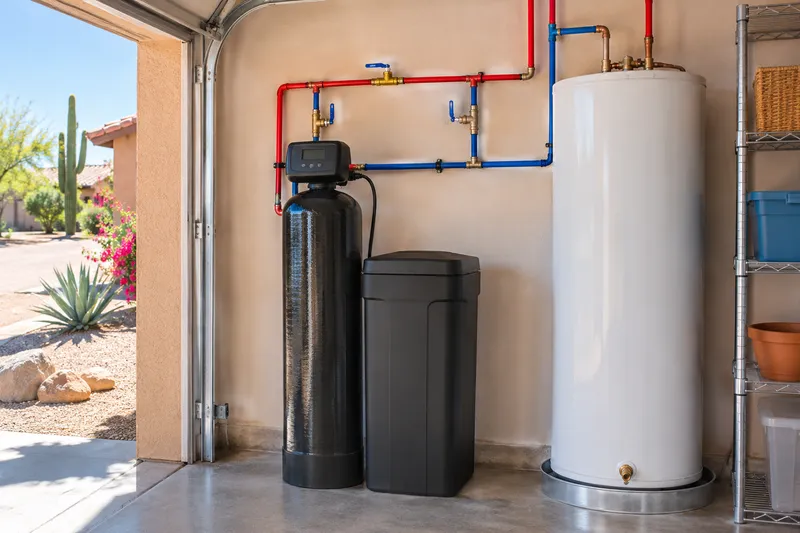
Scale is the bigger problem. A water softener ahead of the heater cuts it down a great deal, which is why many homes pair the two. Our guide to hard water and your plumbing explains how softeners help.
Even with a softener, the heat exchanger should be descaled on a regular schedule and the inlet filter kept clean. Most makers list both jobs in the owner manual.
If your home has a softener, keep its salt topped up. A softener that runs out of salt lets hard water straight through to the heater, and scale can start building again within weeks.
Descaling, filter cleaning and other tankless service
A tankless repair visit usually includes some or all of this work, depending on what the plumber finds.
| Service | What it involves | Why it matters |
|---|---|---|
| Descaling the heat exchanger | The service valves are closed and a small pump circulates a descaling solution through the unit, then it is flushed clean | Restores heating and stops overheating faults |
| Cleaning the inlet filter | The small screen where cold water enters is removed and rinsed | Keeps flow high enough for the burner to stay on |
| Checking the venting | The vent pipe and air intake are inspected for blockage, damage and loose joints | Lets the unit breathe and vent safely |
| Testing ignition and sensors | The igniter, flame sensor and temperature sensors are tested | Finds the cause of no heat and repeated codes |
| Inspecting valves and fittings | Service valves, the relief valve and the connections are checked for drips | Catches small leaks before they damage the unit |
If your unit has no service valves, the plumber can fit a pair so future descaling is quicker and simpler.
How a plumber works through a tankless fault
This is the usual order of a tankless water heater repair in Bullhead City, starting with the code on the display.
Read the code and history
The plumber reads the error code and any stored fault history, and asks when the problem started and how often it happens.
Check water, gas and power
Flow at the inlet, the gas or electrical supply and the venting are checked, since many faults start outside the unit itself.
Clean and test parts
The inlet filter is cleaned, the heat exchanger is descaled if needed, and the sensors and igniter are tested one by one.
Run it under load
Several hot taps are opened at once to make sure the unit holds its temperature at full demand without cutting out.
If a part has to be ordered for your model, the plumber will explain what failed and whether the unit can still be used safely in the meantime.
When a tankless heater is worth repairing
Most faults that lead to tankless water heater repair in Bullhead City can be fixed. A few cannot, and the plumber will tell you plainly which you have.
Repair usually makes sense when
- The heat exchanger is sound and only needs descaling
- A sensor, igniter, fan or valve has failed
- The unit has been looked after and is not near the end of its life
- Parts are still available for the model
Talk about replacement when
- The heat exchanger is cracked or leaking
- Scale damage keeps coming back despite descaling
- Parts are no longer made for the model
- The unit is too small for the hot water your home now uses
Habits that keep a tankless heater running well
A little care between visits keeps most tankless units out of trouble.
Clean the inlet filter every few months
The inlet filter sits where cold water enters the unit. Close the cold water service valve, unscrew the filter, rinse it and refit it. The owner manual shows the exact spot on your model.
Keep the air intake and vent clear
Dust, leaves and even nesting birds can block the intake or the vent outlet. Take a look whenever you are near the unit, and keep plants and stored items away from it.
Descale on a schedule
With hard water, the heat exchanger needs descaling more often than the manual may suggest for softer water. Homes without a softener need it most. A plumber can fit service valves to make the job easy.
Watch for slow changes
A unit that takes longer to deliver hot water, runs louder or shows the same code more than once is warning you. Small faults are far easier to fix than a heat exchanger damaged by scale.
Protect an outdoor unit on the rare freezing night
Outdoor tankless units have built in freeze protection, but it needs power to work. If a hard freeze is forecast and the power goes out, follow the manual's steps to drain the unit so water cannot freeze inside the heat exchanger.
Know where the shut off valves are
Find the gas valve and the water service valves below the unit before you need them. If the unit leaks or smells of gas, you will want to close them quickly. Our guide to finding the main water valve shows where the house valve usually sits.
Tankless water heater questions
Why does my tankless heater shut off in the middle of a shower?
Usually the flow through the unit has dropped too low, often because of a clogged inlet filter or a scaled shower head, or the unit is overheating from scale. Cleaning and descaling fix most cases.
How often should a tankless heater be descaled?
The right interval depends on how mineral heavy your water is and on how many hot showers and loads of laundry the household runs. Without a softener, descaling is needed more often. The plumber can look at the heat exchanger and suggest a schedule. Many owners find it easiest to book it at the same time every year.
Can I descale my tankless heater myself?
Some homeowners do, if the unit has service valves and they have a small pump and the right solution. Follow the maker's steps exactly. If the unit shows codes afterward, call us.
What do the error codes mean?
Each maker uses its own codes. Most point to ignition, flame, flow, temperature or venting faults. Write down the code and the model number before you call, so the plumber knows what to check first.
Do you repair electric tankless heaters?
Yes. Electric units can lose heat from a failed element, a tripped breaker or a faulty sensor, and they need descaling just like gas units. Because they draw a lot of power, the plumber also checks the wiring connections for signs of heat or loosening.
What if my tank water heater is the problem instead?
Our water heater repair page covers tank heaters, from pilot lights and elements to leaks and sediment. If you cannot tell which kind of heater you have, just describe it when you call.