Leak Detection in Bullhead City, AZ
If you can hear water running or your meter will not stop, a licensed local plumber can track the hidden leak down.
See how the leak search worksHow leak detection in Bullhead City homes works
Leak detection in Bullhead City is careful detective work. A hidden leak can sit under a concrete slab, inside a wall or out in a gravel yard, and the goal is to find it before anything gets opened. A plumber usually works through these four stages.
Confirm the leak
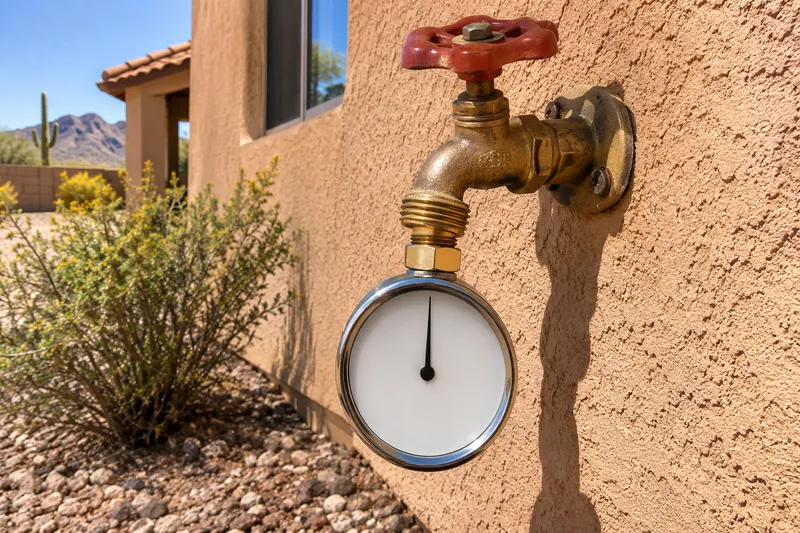
With every fixture off, the plumber watches the meter and runs a pressure test to prove water is escaping and to measure how fast.
Split the system
Closing valves one at a time separates the house from the yard line and the hot side from the cold side.
Trace the sound and heat
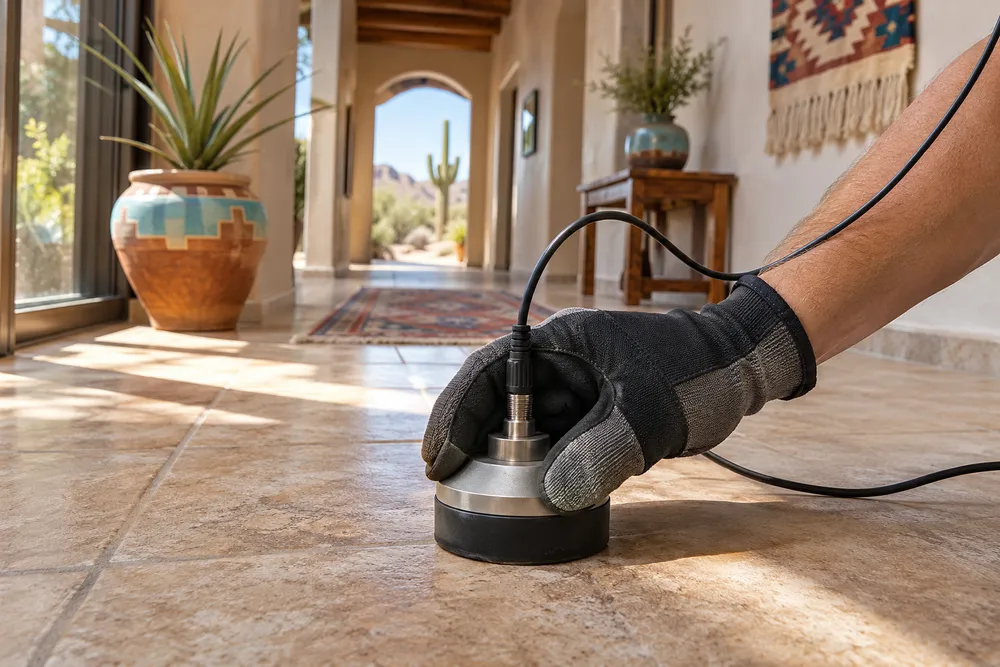
Listening gear follows the hiss of water through floors and walls, and thermal imaging shows warm water spreading on a hot line.
Mark and explain
The leak is marked on the floor, wall or ground, and the plumber explains what failed and how it can be repaired.
Most leak searches take time, so let the plumber know about anything you have noticed, such as a warm floor, a stain or a sound that comes and goes.
Good reasons to book a leak search
You do not need to see water to have a leak. Any of these is enough reason to have the plumbing tested.
- Your water meter moves while nothing in the house or yard is running
- The water bill rose sharply and your habits have not changed
- You hear hissing or trickling inside a wall or under the floor
- A patch of floor feels warm in bare feet
- Paint is bubbling, drywall is soft or a baseboard is swelling
- A musty smell lingers in one room or closet
- A section of gravel or soil in the yard stays damp in dry weather
- Water pressure has dropped at every tap in the house
If you have already done a meter test, tell us the result. It helps the plumber decide where to start.
The tools a plumber uses to find a hidden leak
No single tool finds every leak. A plumber combines several, starting with the simplest, until the readings agree on one spot.
| Tool or test | What it tells the plumber | Where it helps most |
|---|---|---|
| Meter watch | Whether water is leaving the system at all, and roughly how fast | The first check on every visit |
| Pressure gauge | Whether a line holds pressure once it is closed off | Separating the hot line, the cold line and the yard line |
| Acoustic listening gear | The sound of water escaping under pressure | Leaks under tile, concrete and gravel |
| Thermal imaging | Warm areas where hot water is spreading | Hot line leaks under floors and inside walls |
| Moisture meter | How wet drywall, baseboards or flooring are | Confirming a wall or floor leak and how far it spread |
None of these tools needs holes in your floor or walls. Openings come later, and only once the leak has been found.
Read your water meter before the plumber arrives
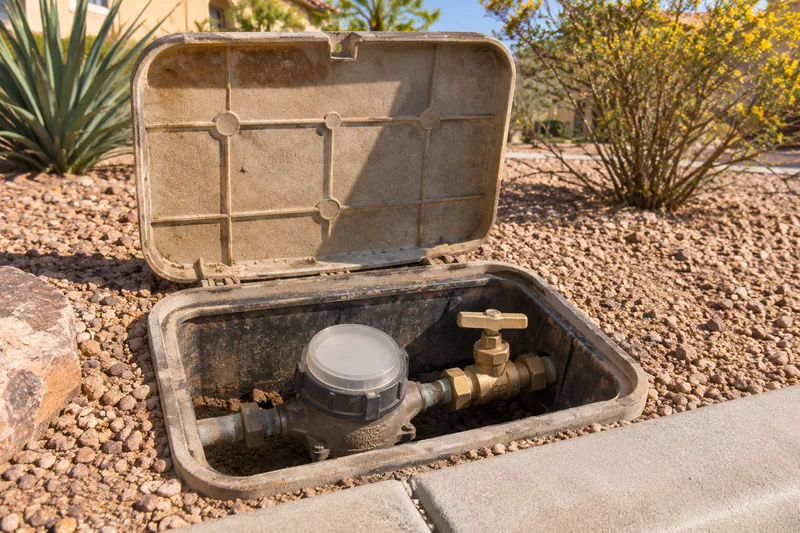
The meter is the most honest witness to a leak. It sits in a box near the street, and most have a small dial or triangle that spins when water moves through it.
Shut off every fixture, the irrigation timer and the softener if it is regenerating. Then watch the dial for a few minutes. If it moves, note the reading, wait an hour without using water and check again.
Our guide on why your water bill is so high explains this test step by step, and the guide to finding the main water valve shows how to stop the flow if the leak is large.
A leak that is getting worse or one that is holding steady
Most hidden leaks start small. Watch for changes, because they tell you how quickly to act.
Act today if you notice
- The meter dial turning faster than it did a few days ago
- Water appearing on a floor, through grout or along a wall
- A warm patch on the floor that is getting larger
- Damp drywall near an electrical outlet
You can book a visit if
- The meter creeps slowly and only during a careful test
- The bill rose once but nothing feels wet or warm
- A faint sound comes and goes late at night
- A small stain has not grown for several weeks
Less obvious places a leak search can lead
Most leaks turn up beneath the concrete, behind a wall or out in the gravel. These are the cases that surprise homeowners.
Lines that run through the attic
Some homes have water lines in the attic, often where a line was rerouted away from the slab. Attic heat in summer is hard on fittings, and a drip there may only show as a ceiling stain weeks later.
Thermal imaging and a moisture meter on the ceiling below can confirm it. The plumber checks the attic run from above once the area is narrowed down.
The connection to the irrigation system
Drip systems and sprinkler lines in gravel yards connect to the house supply. A cracked fitting or a valve that does not close fully can let water run between watering cycles.
Turning the irrigation off at its own valve during a meter test shows whether it is the source. If it is, tell the plumber what kind of system you have.
Testing again after the repair
Once a leak is repaired, the plumber repeats the pressure test and watches the meter. A line that now holds steady confirms the job is done.
If the meter still moves, there is a second leak, and the search continues from where the first one ended. Finding both on the same visit spares you a second wet floor later.
What you have in hand when the search is done
A leak search ends with an answer, not a guess.
The plumber shows you where the leak is, which line it is on and how they found it. You also hear what likely caused it, whether it is a pinhole in copper, a failed fitting or a line rubbing against concrete.
Then the plumber explains the repair options, from a small opening and a spot repair to rerouting a line. The choice is yours, and no floor or wall gets opened until you agree.
If the readings point to more than one leak, the plumber will tell you that too, so you can plan the repairs in a sensible order. In an emergency, our plumbing emergency steps explain what to do while you wait.
Leak detection questions we hear on the phone
Will you have to break into my walls or floor to find the leak?
Not to find it. Pressure tests, listening gear, thermal imaging and moisture readings work from the surface. An opening is only needed for the repair, and the leak search keeps it as small as possible.
How long does a leak search take?
A simple leak can be found quickly. A small leak under a large slab takes longer, because the plumber has to isolate lines and listen carefully. The plumber can give you a better idea once the first tests are done.
My meter moves but I see no water anywhere. Where could it be?
The usual suspects are a toilet leaking into its bowl, a slab leak or the buried yard line. A toilet dye test rules out the first. Pressure tests on the house and yard lines narrow down the others.
Can hard water cause hidden leaks?
It can play a part. Minerals and the water itself wear the inside of copper over time, and worn spots can become pinholes. Our guide to hard water and your plumbing explains what scale does inside pipes.
Do I need to shut the water off before the plumber gets here?
If you can see water spreading, close the main valve right away. A slow leak found only by a meter test usually allows normal use until the plumber arrives, as long as you keep checking the meter.
Does the softener or irrigation system affect the test?
Yes. A softener that is regenerating and an irrigation timer that starts a cycle both move the meter. Turn them off or wait until they finish before doing your own meter test, and tell the plumber about them.